Oil Surges 3.5% as Strait of Hormuz Closes Amid US-Iran Conflict
WTI crude climbs to $73.90 as Hormuz shipping halts and both sides exchange strikes, rattling global markets.
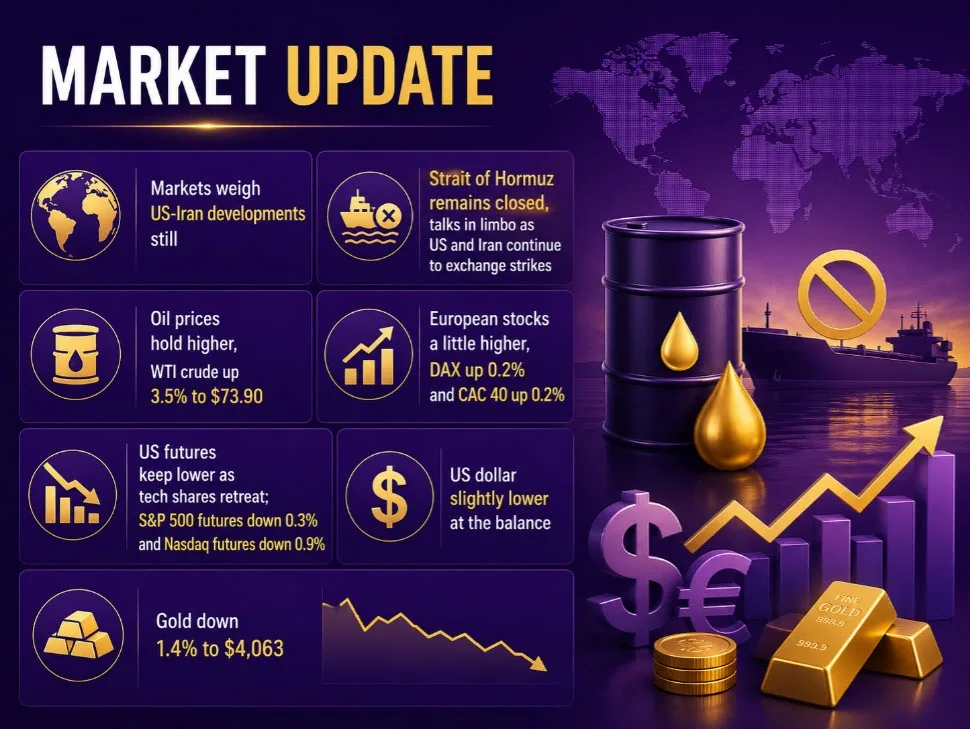
Global markets opened the week under a familiar shadow: the escalating standoff between the United States and Iran. With the Strait of Hormuz — a critical chokepoint through which a significant portion of the world's seaborne oil transits — effectively closed and both sides continuing to exchange strikes, energy markets responded sharply. WTI crude surged 3.5% to $73.90, consolidating near recent highs as traders priced in sustained supply disruption risk.
Diplomacy has offered little relief. Iran's foreign ministry acknowledged that third-party mediators are still working to de-escalate, but Tehran simultaneously reaffirmed it will not honor its commitments under any agreement as long as Washington fails to do so. That circular standoff leaves markets without a clear off-ramp, and the geopolitical premium in oil looks unlikely to unwind quickly. The combination of halted Hormuz traffic and ongoing military exchanges makes this more than a headline risk — it is a tangible supply threat.
Read more Adobe Stock Jumps 5.6% But Trades Far Below Estimated Fair Value →
Equity markets are reflecting that unease unevenly. European stocks held relatively steady, but US futures pointed lower, with S&P 500 futures off 0.3% and Nasdaq futures sliding 0.9%, weighed down by tech-sector weakness. The dollar, typically a safe-haven beneficiary in moments like this, saw its early-session gains partially reversed — EUR/USD edged up to 1.1430 and GBP/USD steadied near 1.3390 — suggesting investors are not in full flight mode, but remain cautious.
Beyond the Middle East, monetary policy is adding another layer of complexity. Federal Reserve Governor John Williams signaled he would back interest rate hikes if monthly core inflation consistently runs above 0.2% on average — a threshold that keeps the Fed's tightening bias alive even as geopolitical uncertainty clouds the economic outlook. Ten-year Treasury yields ticked up one basis point to 4.579%, hovering near June highs. Gold, despite the risk-off backdrop, fell 1.4% to $4,063, while Bitcoin declined 2% to $62,863, suggesting some investors are rotating toward cash rather than traditional hedges.
The week's defining data point will be the US CPI report, which arrives as markets are already grappling with a volatile geopolitical backdrop. How inflation reads against the Fed's implied threshold could determine whether rate-hike expectations re-accelerate — compounding pressure on equities and risk assets already unsettled by events in the Gulf. Continue reading at Forexlive.