Oil Slips as Iran Signals Diplomacy; Equities Stabilize
Iran's acknowledgment of active mediation efforts cooled an early oil price spike, giving equity markets room to recover from Friday's losses.
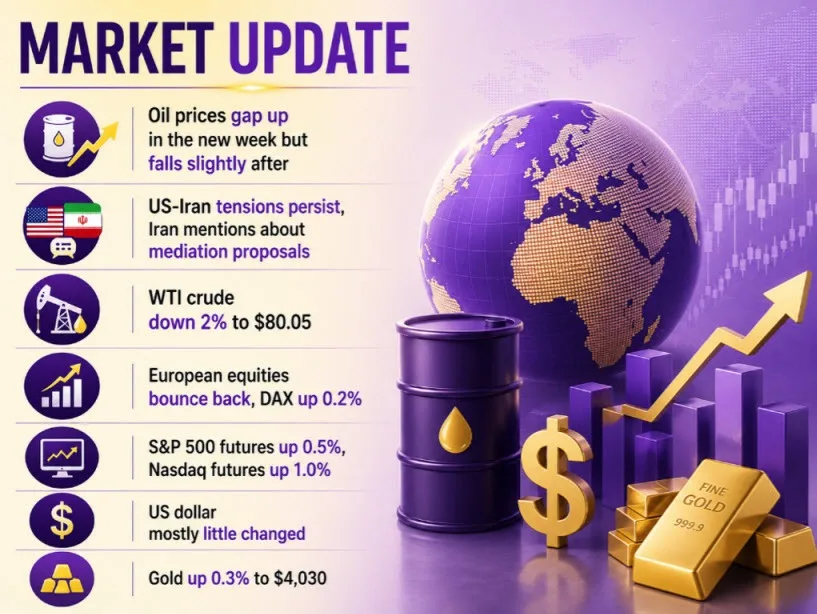
Global markets opened the week on edge as the US-Iran conflict continued to set the tone across asset classes. Oil gapped higher at the start of Monday's session — a reflexive move reflecting weekend anxiety — but quickly surrendered those gains once Iran's foreign ministry spokesperson confirmed that mediation proposals had been received from several parties and that diplomatic channels remain active. WTI crude slid roughly 2% intraday to $80.05, underscoring how sensitive energy markets remain to even modest signals of de-escalation.
Equity markets, which had taken a beating on Friday, found their footing during European hours. Major European indices opened in negative territory before drifting modestly higher, while US futures extended that recovery: S&P 500 futures gained 0.5% and Nasdaq futures climbed 1.0%. The bounce is meaningful in directional terms but should not be overstated — it follows a bruising selloff, and analysts would be right to characterize the mood as cautious rather than confident.
Read more Adobe Stock Jumps 5.6% But Trades Far Below Estimated Fair Value →
The currency market offered relatively little drama. The Australian dollar was the session's standout mover, rising 0.4% to 0.7010 against the dollar, while the euro held flat near 1.1435 and USD/JPY barely budged around 162.30. The muted dollar action suggests that traders are not yet repositioning aggressively for a prolonged conflict scenario, though the situation remains fluid.
Gold edged up 0.3% to $4,030, but the ECB's latest SAFE survey — which showed easing inflation and wage-growth expectations among euro-area firms — added a nuanced counterweight. The survey's finding that upside risks persist means central bankers cannot yet declare victory on price stability, a dynamic that keeps rate-cut timelines uncertain and complicates the safe-haven calculus for gold. Ten-year US Treasury yields ticked only marginally higher to 4.547%, suggesting bond markets are not pricing in a runaway inflation shock just yet.
The day's key takeaway is that diplomatic signaling, even preliminary and unverified, carries enormous market weight when geopolitical risk is the dominant variable. A single statement from Tehran was enough to trim an oil premium and stabilize risk assets — a reminder of how quickly the narrative can shift in either direction. Continue reading at Forexlive.