Iran-US Military Clashes Escalate as Oil Markets Stay Calm
US strikes hit Iranian infrastructure and Gulf bases take missile fire, yet oil prices show surprising restraint amid diplomatic signals.
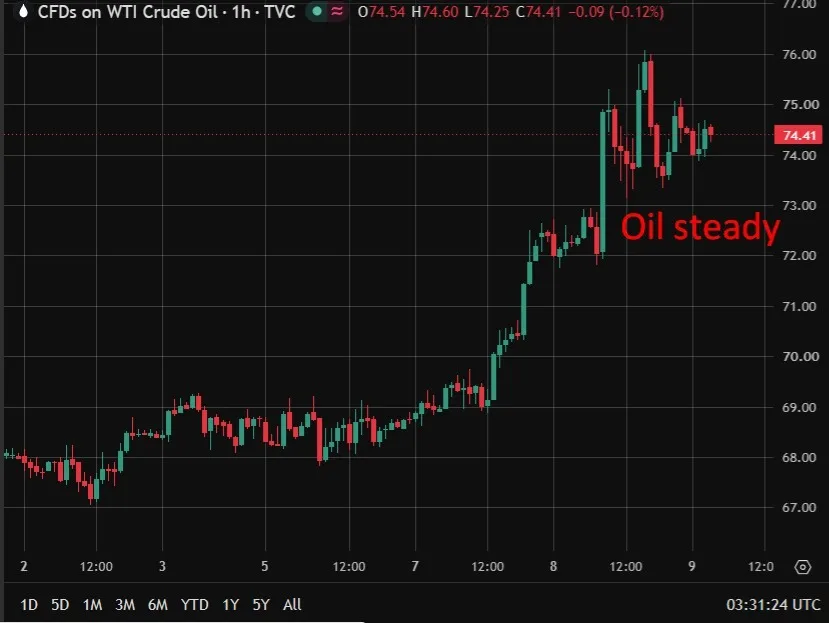
A significant escalation in the Iran-US confrontation unfolded during the Asia-Pacific session, with American forces striking approximately 90 Iranian coastal military targets — including air defense systems, missile and drone storage sites, and naval logistics infrastructure — according to CENTCOM. In a notable first since a prior ceasefire lapsed, US cruise missiles destroyed two railway bridges in Iran's Golestan province, a strike that Axios attributed to a senior official citing reporter Barak Ravid. The targeting of civilian infrastructure marks a qualitative shift in the conflict's trajectory, moving beyond purely military assets.
Iran's response was swift and multi-front. The Islamic Revolutionary Guard Corps declared it would retaliate for the bridge strike, while Iranian missiles struck US military bases in Bahrain and Kuwait, triggering air raid sirens across the Gulf. Parliament Speaker Ghalibaf issued a pointed warning that the Strait of Hormuz — the critical chokepoint through which roughly a fifth of the world's traded oil passes — would only reopen under specific conditions, a threat that carries enormous economic weight for global energy markets.
Read more Adobe Stock Jumps 5.6% But Trades Far Below Estimated Fair Value →
Yet oil's reaction was, by the standards of the news flow, remarkably subdued. After an earlier session that saw crude jump roughly 7% on threats of expanded strikes targeting Kharg Island, prices stabilized with only modest further gains during the Asia wrap. This restraint likely reflects two countervailing forces: the market's awareness of the Hormuz threat on one side, and a concurrent diplomatic signal on the other — President Trump stated that Iranian officials had contacted Washington seeking a deal, a claim that injected just enough uncertainty to cap the risk premium.
Elsewhere in the Asia-Pacific session, regional data added its own complexity. China's factory-gate inflation hit a four-year high even as consumer prices came in below expectations at 1% year-over-year against a 1.2% forecast, a divergence that complicates the PBOC's policy calculus. South Korea's Bank of Korea flagged a potential rate hike as domestic inflation runs at multi-year highs, while chipmaker strength lifted both the Kospi and Nikkei despite the geopolitical overhang. The session underscored how markets are simultaneously processing conflict risk, central bank divergence, and fragile diplomacy — a combination that rarely resolves neatly.
Continue reading at Forexlive.